Sunday, January 18, 2009

"Don't go callin me wally"...


Iconic actor/director/producer Clint Eastwood’s newest film Gran Torino tells the story of what would happen if Dirty Harry retired from the auto industry and lived in the suburbs. Ok, not exactly, but it does further cement his reputation as a man now well into his late 70’s who is truly a legendary force both behind the camera and in front of it. Walt Kowalski (Eastwood) is the rock that although has been aged and hardened by the rivers of life, hasn’t budged an inch for years. He likes his cars, his beer and coincidentally, his neighbors, all the same way; American made and American born. A retired Korean War Vet, for nearly 50 years he has lived on the same block and worked for the same Ford company, alienating many of his family and closest contacts along the way. After the passing of his wife, Walt defiantly insists on changing virtually nothing in his pace or routine, despite the jest of his family members. Walt sharply holds onto his deep-seeded prejudices when a Hmong family moves in next door. Their lives collide when the youngest boy Tau attempts to steal Walt’s coveted 1972 Gran Torino car in response to neighborhood gang pressure. Through a series of cinematically programmed moments, Walt begins to lead the boy away from a life of gang-related violence.

There is a particular arc to this story that is never fully satisfied by its payoff. Much of Kowalski’s family is written into the script in order to set up Kowalski himself. They do little to drive the plot in any way on their own. His wife is all but absent from the story, mentioned only in passing. I couldn’t help but wonder what kind of woman she must have been to live with such a man for so long! The real treat here is to watch Eastwood perform with relentlessly channeled emotion. He still manages to easily convince us that he is indeed as tough as nails, and not just because it sounds like he is chewing them during every line of dialogue. He plays the character with such restrain and physical control, that we feel like the next word, the next push could finally set him off, without ever fully realizing such a climactic moment. The audience believes that it is Kowalski himself who is the only one who truly knows what he is capable of, and the tension it creates is genuinely palpable.

In the end Gran Torino has a little bit to say about the possibility for good to reside in all people, in any stage of life. It also has a bit to say on the responsibility that comes with understanding race relations in the ever-widening melting pot that is American culture. It is the presence and signature of a Hollywood veteran though that will tower over the film itself, long after the credits roll.

3/5

Friday, December 26, 2008

The Daunting task of the dark campaign


So I just stumbled across this website the other day by chance. www.thedarkcampaign.com is the official website of the unofficial grassroots campaign dedicated to getting The Dark Knight a win for best picture at the 2009 academy awards. If you're like me you might be asking yourself how could the "votes" of tons of online campaigners hold any weight with the same committee who in 2007 handed out acting awards to people whose names most Americans couldn't even pronounce, let alone had ever heard of?

The academy awards in case you didn't know have very little to do with audiences as they do with the votes of elite members who have earned their spot in the snobbery.. I mean..sophistication of deciding who is the best of the best. The Dark Knight has the deck stacked against it already in that it is a comic book movie, and the city in which the awards take place, already named WALL.E the best movie of the year. I'm still not convinced it should be in the category of best 5 of the year, but I can at least appreciate the efforts of a few idealistic cinephiles out there who want to see oscar history. I would think that if the Academy wants to continue to have the annual celebration televised, they would do well to listen to the pleas of such fans. The last few years, the show has boasted some of the lowest viewer ratings in history. Last year was an all time low when the majority of the films nominated made very little impact on box office sales. Something tells me that if even if the show sunk as low as to have ABC drop the historic program, the Academy would still find a way to pat themselves on the back in private and still do the show.

Picture with me if you will, an oscar show with at least 3 of the best picture nominess being DK, WALL.E, and Benjamin Button. Right there you have a show that promises potential big star nominations and the celebration of movies that millions of people paid money to see. The Dark Knight may or may not be deserving of the nomination, but I have to admit that the mere watchability of a show like that definitely peaks my interest more than watching people glorify something like Soderbergh's 4 1/2 hour biopic Che.

Whether or not you loved the film, you should defintely check out thedarkcampaign.com Note some of the critics' quotes on the trailer and how ridiculous some of them sound. This alone might make you believe that the creators of the site may be shooting for the moon.

‘Tis the Season..for Joy/Frustration


It’s that time of year again in which masses of movie critics will roll out their “self-appraised” top 10 lists. I have to admit that this time of year always fills me with at least a formidable amount of excitement. It’s always interesting to see what films make everyone’s list, which ones everyone has been talking about, and which ones they would most like to forget at year’s end. In recent years however, this annual occurrence has filled me with equal parts joy and frustration. Think about this: Does it not seem a tad bit pretentious to dogmatically list the so-called “best” of 2008 as if said critic’s opinion is the final answer on any question that presumes to answer what the best films truly are? I think part of my concern with turning movie criticism into such a science comes out full force when the “best-of” lists come out ever year. The problem with ranking 10 films is that you inevitably leave truly great films on the cutting room floor. Great films and their filmmakers should be celebrated, and sadly, top 10 lists seem to glorify more and more predictably each year, the same type of movie.

I have heard it said for example, by more than one critic this year that this was a bad year for cinema. This air of pomp and stuffiness is usually offered as an explanation of why such a critic felt it necessary to litter his/her top 10 lists with films that premiered in 2007.(i.e. Paranoid Park, Snow Angels, etc.) While it is safe to say that I shared an equal affinity for films like these, I would add that what some critics may think was a bad year for “cinema” was actually a great year for movies. This year was the first in a long time in which an animated movie literally made me stand up and cheer, more than one comic book movie captivated me with every frame, and seemingly formulaic plots filled me with intrigue and excitement (for this last point see Danny Boyle’s Slumdog Millionaire in order to really understand what I’m talking about.) What the awards season has shown us for the majority of the last decade is that there has been an ever-increasing chasm in the movie industry between the highest form of cinema and genuine popcorn blockbusters. Since the Coen Brothers’ Fargo in 1996, there has been at least one or more independent film nominated for best picture every year. While I have been excited as anyone with a genuine love for movies with the trend, I have to admit that I do miss films that are loved by audiences and critics alike. Gone are the Forrest Gump’s and Shawshanks of our day that touch a fabric in virtually every audience, critic and casual alike. I guess what I’m saying is that when the filmmakers who lash out against formula make films that in and of themselves are formulaic, what are they really trying to prove? And what is the academy trying to prove by nominating them? Think back upon 2005 in which virtually every oscar nominated best picture was highly political and/or completely non-commercial in virtually every way. I’m not saying that this is entirely bad, but what I am saying is that it is starting to leave some annoying marks on the movie industry.

I wonder if we have come to a point in which winning an award is the end all of a filmmakers’ career. What the awards season has shown us is simple. Hold off the release of your film until November or December and you will be most likely get nominated. Every Golden Globe nominee for best picture this year was for a film that was released in November or December, some of which weren’t even in wide release at the time of their nominations. The problem with this is that it smacks of formula. After seeing Clint Eastwood’s Changeling this year, I am absolutely convinced that the man has an oscar algorithm in his notes. Just put some actors in front of a camera and make them talk about things that no one wants to pay 8 dollars to hear about. You know, mass murder, child abduction, pedophilia, etc. Don’t let anyone see your film until a couple months before release, and you might have a chance of brining home the statuette. I recently heard that the release of the adaptation of Cormac McCarthy’s The Road had been delayed until 2009. Apparently post-production was taking much longer than expected. The delays have been so lengthy that director John Hillcoat was actually considering holding the film until next November. For those of you keeping score, this is nearly one year after the original release date. And why such a delay for a film that will be long finished before then? Why, for Oscars of course.

So why should this concern you and me as a movie lovers? Well, I guess in all actuality we shouldn’t lose that much sleep over it, but when we the people make our top 10 lists, lets try to do what so often the award shows fail to. Let’s celebrate really good films and the people who make them. This year boasted many such films, domestic and foreign. Hopefully, this will be the year in which the Oscars overlook the “formula” for more “unconventional” stories. Like a little robot with big ambitions for example… In a few weeks I will add my small and insignificant voice to the masses, and I will sit back and reflect upon the 10 “best” of the year for me. They will be 10 films that stuck out the most, and left the deepest impression upon me in 2008. I will not even begin to try to rank them, but I hope that in the process I will be able to celebrate good movies, people who love them, and introduce at least someone out there to a new favorite film.


Until then, here are at least two that are in the running that you might not have seen yet.

Gus Van Sant’s Paranoid Park- 4/5 – A high school student is involved in the accidental murder of a security guard at the skate park. After the incident he chooses to tell no one and then tries to deal with the consequences. Extremely interesting, and directed with great flair. Serves as interesting counterpart to Van Sant’s other more conventional ’08 biopic Milk.

Chop Shop¬ – 4/5 – tells the story of 2 kids living in the salvage yard streets of Queens, and their own journey to find hope and stability. Brilliant direction, and incredibly moving performances.

Monday, December 15, 2008

Break out the egg nog..it's holiday movie time.


Every year it seems like the Christmas season starts a little earlier than it did the year before. Retailers begin rolling out the red carpet for shoppers just about as fast as they pack away all the Halloween candy and costumes. Ever gone into Wal-Mart on November 1st? Halloween is like the dirty secret that never happened, and this year the twenty foot Christmas tree and bell ringers greeted me undoubtedly a few hours after the fall decorations had been taken down. Hollywood is no different, and each year you can bet that a slue of holiday movies will hit the box-office with little or no fanfare to support them. Much like their corporate counterparts, these films are here one day, and gone the next, and chances are, you won’t remember most of what happened in them. Perhaps this is the reason I staved off the chore of seeing Four Christmases until mid-December despite its Thanksgiving release. I knew it was one of those films that I would inevitably end up writing about, and correct me if I’m wrong but didn’t Vince Vaughan’s Fred Clause just come out on DVD? The film pits Oscar-winning Reese Witherspoon alongside Vince Vaughan for some formula-based holiday mayhem.

For quite some time now, Brad and Kate have made their annual Christmas vacation about spending time with each other, away from their unsuspecting families. This year is no different. When the young and energetic couple’s flight to Fiji is cancelled at the last minute, they are forced to spend Christmas with their families. What you need to know is that Brad and Kate have built their entire relationship upon making their own rules, and this means avoiding any type of serious commitment. It’s why they still haven’t tied the knot, and are prone to spending the holidays sipping mai tais rather than playing board games with their families. Hmmm. Seems like an hour and a half is just enough time for these characters to learn a valuable lesson about family. Oh yeah, both characters come from divorced families as well. Hence the title.

Here’s the point. If you’re a sucker for Vince Vaughan, (which I admittedly am) then go see this movie. If you’re with the fam during the holiday and trying to decide on a movie to go to, you could probably do worse. Just don’t expect to remember much of what you saw a year later. Especially if, God forbid, Vaughan stars in Fred Clause 2: The Buy-out Clause in 2009. At times you will probably laugh, but you just might glance at your watch a few times as well. I did both. The film boasts a surprisingly talented all-star cast. I won’t name names here because to do so would ruin the fun of meeting the family members yourself. Now if you’ll excuse me, I’m headed off to the living room to dust off some Christmas nostalgia and put It’s a Wonderful Life into the DVD player.

2.5/5

Sunday, December 7, 2008

"It's impossible....let's get to work."


On August 7th, 1974 young Frenchmen Philippe Petit went from virtual anonymity to worldwide celebrity in a matter of 30 minutes. Petit committed what came to be known as the “artistic crime of the century” when he danced across a wire he had illegally strung between the two world trade center towers. On-lookers stood agape as they marveled at the man 1,350 feet in the air appearing to float across the sky. He was truly inspired, truly brave, and almost certainly mad. James Marsh’s mesmerizing documentary Man on Wire tells the intriguing story of one man’s obsession to do something that challenges the realm of possibility. Through a combination of archival footage, dramatized re-enactments, and interviews with Petit and his crew, Marsh attempts to tell the story of how Petit was able to pull off the ultimate ‘heist' and accomplish an incredible task. The result is a film that stirs the emotions, and quickens the pulse.

Philippe Petit’s obsession with the World Trade Center towers began before they were even built. As a youngster, the story tells us that he first learned of their upcoming construction in a magazine article while waiting in a dentist’s office. There is no other explanation from this point as to what exactly drove Petit to do what he did, other than that the towers seemed to be calling him to do something magnificent. Marsh brilliantly leaves the ‘origin story’ of this character virtually absent. There is literally nothing we can point to in order to explain the veracity with which he pursued his outlandish goal. Marsh ultimately decides it is better to offer insight to this man the same way Petit responds to a reporter upon his arrest. When asked why he committed the crime, he simply answers: “There is no why”. Instead there is a zeal, a furor for living life on the edge in such a way that to die is only worth doing, if it is in the throes of something which you are passionate about. The story is as taut and thrilling as any crime caper movie. The suspense is so heightened that there are times you will literally remind yourself “It’s ok. I know he’s going to come out alive!”

Man on Wire does what few films, let alone documentaries, are able to. It plays on all of your emotions, and still leaves with you the same sense of wonder that caused all those New York passers-by to gawk upward into the sky that magical day. Ultimately, Petit is neither a hero, nor a tragic case study, but a parable. In a way in which he never probably planned, his fanciful ideals call us to look at our lives and see the possibilities that lie before us in ways we never thought possible. The film’s message, in as much as it even has one, is probably best described in the words of Petit himself. “Life should be lived on the edge. See everyday as a true challenge, and then and only then do you live your life on a tightrope.”

5/5

Sunday, November 30, 2008

Just because it is doesn't mean it should be....an epic


All right, I’ll admit it. I’m a sucker for Hollywood. I say that not in my defense, but in my self-discovery. After sitting through all 160 minutes of Baz Luhrman’s sweeping epic Australia, I came to the inevitable conclusion that despite its lengthy run time, paint-by numbers plot, and unabashed melodrama, I actually enjoyed the movie. Sure I didn’t buy most of the plot for one second, but since when are we really supposed to believe all of the Technicolor glamour we’ve seen on screen for ages? In the end what did it for me was that the style and execution mostly outweighed the parts that I could have done without.

The world is on the brink of the Second great war, and the demand for beef is rising. Such are the conditions that English aristocrat Sarah Ashley finds herself in when she unexpectedly becomes heir to a cattle station in Northern Australia. When arriving in Australia, Sarah finds herself in the midst of great hardship resulting from cultural differences, and the sudden doom her company finds itself in. Soon, she befriends a young Aborigine boy, dubbed by he country’s intolerable race laws as a “half-caste”. The boy is the son of an aborigine female and a white male, and will soon be forced to a sector of the continent so that “the black may be bred out”. When Sarah discovers corruption within the business she must put her faith in a rough cattle herder known as drover. The three form an unlikely team to try to restore the name of the ranch, and are still forced to deal with the impending bombing of Darwin, Australia by the Japanese militants.

This film is a very deliberate homage to the John Ford epics of the past. Luhrman said himself that he set out to make his own Australian Gone With the Wind, and the comparisons are hard to miss . The actors seem to sparkle on screen in a kind of luster that is reminiscent of the golden age of Hollywood. Australian born Luhrman has a keen knack for visual flair that while is often-times breathtaking is still other times distracting with his over use of CGI shots. Luhrman’s camera urges us to soak up the vast Australian landscape with impeccable tracking shots. The 3-act film has so many plot points that it can be tedious to try and soak all of it in, especially considering the film is nearly 3 hours in length. It is a fantastic film to look at though, with lush cinematography and strong performances practically daring audiences to look away.

3.5/5

A word about ratings....


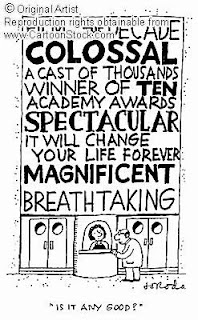
I recently read a brilliant article from Roger Ebert' s blog entitled "you give out too many stars". In it, Ebert goes to great length to defend his position in the terms of legendary critic Robert Warshow: "A man goes to a movie. The critic must be honest enough to admit that he is that man." Ebert, like most of us who view several films a month ultimately do it because we love movies. I use the term movies here in its most classical sense. That is to say, all kinds of pictures. Pictures that inspire, make you laugh, cry, or invoke anger. Pictures that revel in their own campiness, or melodrama. Pictures that sell-out multiplexes for weeks straight. Pictures that are viewed often times in the arthouse theaters that seem to desperately tread water in an industry that earns its bread and butter off of formula. So why am I bringing this up now....?

It has been brought to my attention by a few of you out there who happen to read this blog, that I perhaps suffer from a different type of movie rating malaise: That of the critic/man who is impossible to please. I realize that a lot of this may be from the confusion wrought by my own rating system (needless to say, I thouroughly hate most rating systems that are out there..including my own, but I'll get to that later.) So in an effort to rectify such a perception of "film-snobbery" I would like to clarify my position as a movie fan, and my system, as cut-and-dry as it may seem to be, for trying to gauge them.

The trouble with rating movies is that it is not a science. I'm sure there are countless critics out there who will try to convince you otherwise, but something about that belief just doesn't seem fair to me. A film should best be judged out how well it does what it is supposed to do to you as a member of the audience. In this sense, a film should sweep over you, the viewer. It should in a sense, manipulate you into thinking, feeling or reacting a certain way. This makes for a very hard system of trying to pin down where a film stands in regards to others. There are obvious things to consider of course. Did the story resonate in such a way to sustain interest? Are the characters developed enough for the audience to mainain a strong connection? Are the elements of the plot, and the characters themselves consistent in their actions and themes throughout? The hard part comes in trying to put on a scale of 1 to 4 or 1 to 10 how well the film did what it was supposed to.

The reality is that as a "critic" it is never my intention to 'deconstruct' a film to the point of inviting public debate. I am nowhere near learned enough, or in possession of the adequate tools to embark on such a task. My job is to try to express as best I can, what a film did to me. This is of course highly subjective. Most films, and the reaction they incite, are. There are a few obvious exceptions. I mean come on, who's going to argue that you don't gasp when you first hear Darth Vader utter those dreadful words to Luke about their true relationship? But since most films aren't obviously good, or obviously bad, it leaves much room for differing opinion, which is just that. Opinion. Not formula.

Having said that, let me explain briefly why I have chosen the rating system I currently use. The problem with the 4 star system (as with most systems) is that I feel it leaves too much room for comprimise. There will undoubtedly be certain films that jump from being good to great, or good to bad in order to give an easy-to-read scale. All though any scale should be indeed a mere "snapshot" of the quality of the film, a 4 star-system I feel does not best show the quality of the film in relationship to others. Here is the basic run-down of what each of my stars represent.

1 - This is a movie that I practically hated sitting through. It means that I found virtually no redeeming qualities to speak of, and the film did notihng to engage me, or to keep me involved.

2 - This is a movie that I didn't like. There might have been at least a couple good scenes, or an interesting story idea that either wasn't developed enough for my liking or just didn't work well. Nevertheless, it is not a movie that I would endorse seeing.

3 - This is a movie that I liked. It probably did what it was supposed to, and I enjoyed sitting through it. It it is not necessarily a movie that I would champion, but I would still encourage seeing it.

4- This is a movie that I really liked. It was clearly more engaging than a 3, and the kind of movie that after watching it you know it your gut that it was above a 3.

5- This is a movie that I absolutely loved. It is a rare breed, like the 1 rating, because these are the two extremes that are probably the least subjective. It is a movie that possesses some of the above and beyond qualities that seperate it from any normal movie-going experience. This does not mean however, that it was a "perfect" film.

For those of you who prefer the simple endorsement/no endorsement type of rating system, I will be including a simple "stamp" of approval at the beginning of each review. It will be a symbol that I haven't decided on as of yet, but will be the most basic snapshot of what I thought. Think a smiley face or a check mark for good, and a frowny face or an "x" for bad. I would use thumbs, but in today's lawsuit happy world I'm sure I would find that those symbols are trademarked.

Just for the record,, the "good" movie would fall under the 3-5 category, with the "bad" being 1 or 2.